


November 6, 2026
How I built Block Battle in 2 hours using AI, our API and documentation
What building a location-based game taught me about good API documentation in the age of AI.

Kjartan Slette · Co-founder, Pine59
For years, API documentation has primarily been written for developers. Explain the endpoints, describe the parameters, provide a few examples, and let developers figure out the rest. But something is changing. Increasingly, the first reader of your API documentation won't be a human developer. It will be an AI agent trying to understand your data, how to access it, and what it can build with it.
I recently decided to put this to the test myself at Pine59.
Building Block Battle
I wanted to see whether I could use AI and our own API documentation to build a game based on real location intelligence data, without writing any code myself. I opened Lovable, pointed it toward our documentation, and described the idea.
The result was Block Battle, a game where six Oslo neighborhoods compete using real-world data. Players make Higher or Lower predictions about neighborhood characteristics such as visitation, activity patterns, and nightlife. Correct predictions earn points, with 21 points needed to win. The game turns data normally used for retail analytics and urban planning into something entertaining and accessible.
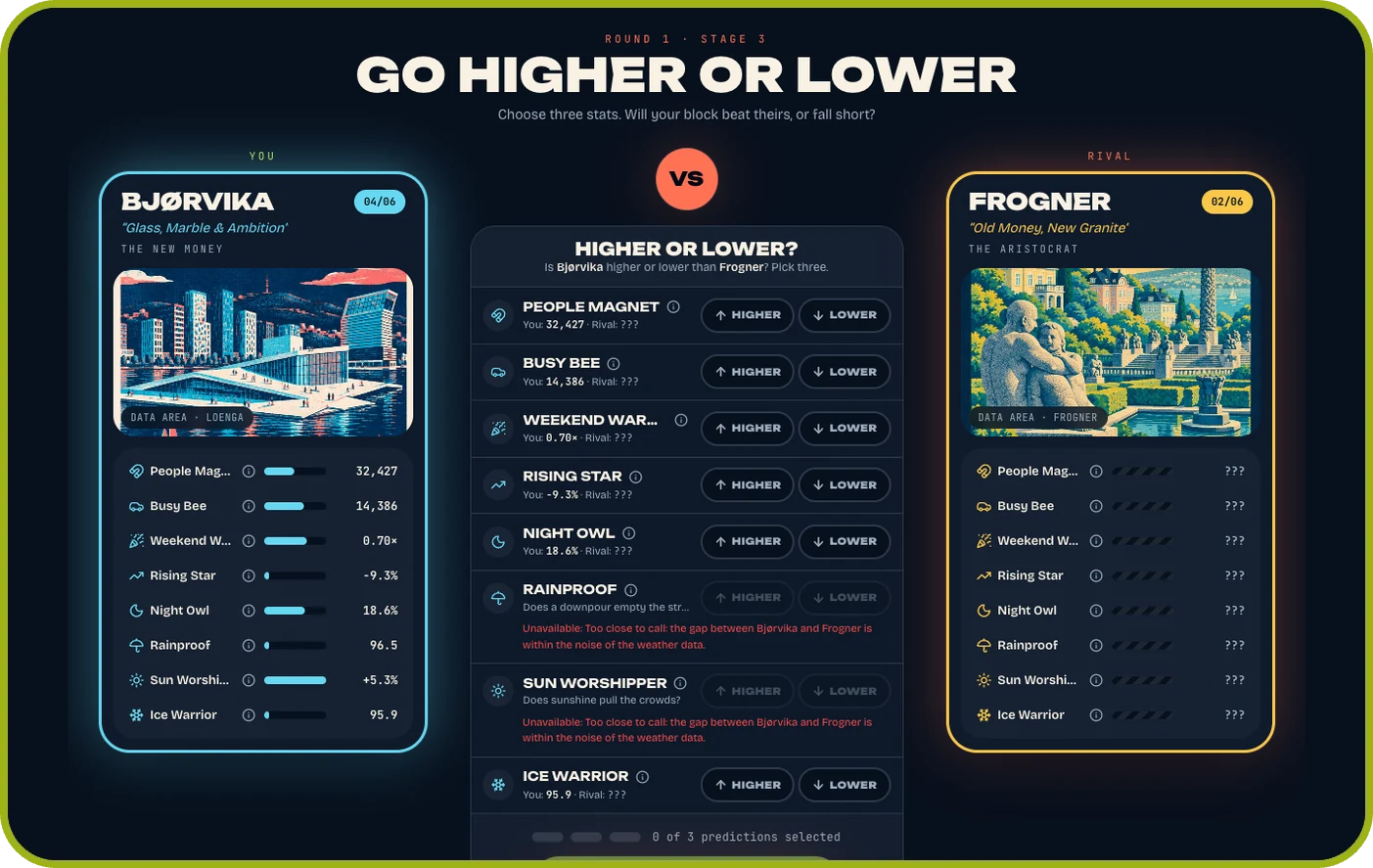
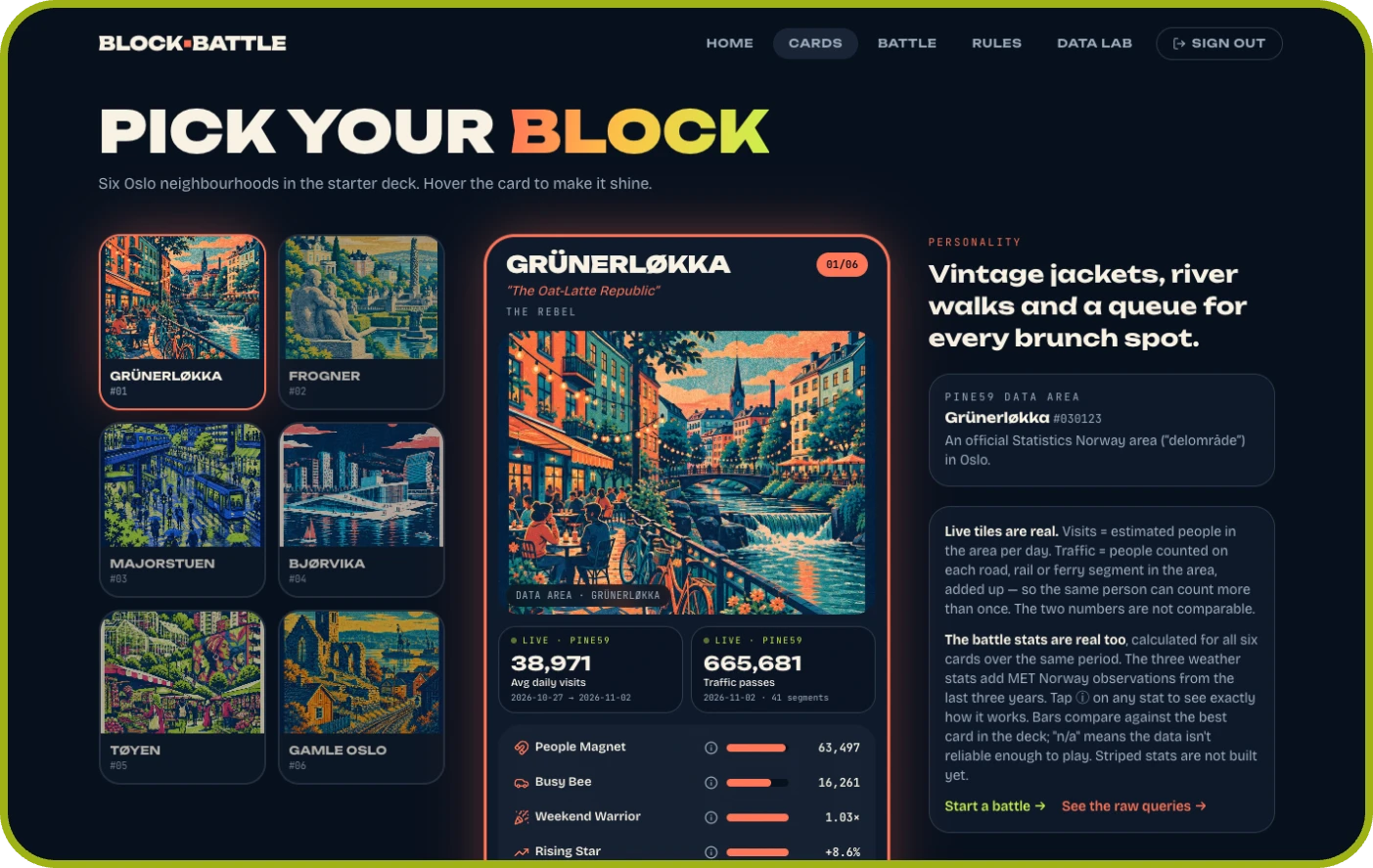
From idea to playable prototype took approximately two hours. No traditional coding, no manually building API integrations, just an idea, an AI development tool, and well-structured documentation.
Why documentation matters more than ever
Traditionally, building something like this would require a developer to study the API, understand the datasets, write queries, interpret responses, and connect everything to an application. AI can now handle much of that work, dramatically reducing the time between an idea and a working prototype.
But only if the documentation is good enough. An AI agent needs more than endpoint descriptions. It needs to understand:
- What the data represents
- How metrics are calculated
- Which comparisons make sense
- Where the limitations are
Otherwise, it starts guessing. And an AI can build an application that looks great and functions perfectly while producing misleading results because it misunderstood the underlying data.
“Good documentation is no longer just about making APIs easier to use. It's about making the data harder to misunderstand.”
Building APIs for an AI future
At Pine59, we're developing our API documentation and guides (opens in a new tab) with both human developers and AI agents in mind. That means:
- Clear definitions
- Logical structure
- Consistent naming
- Machine-readable specifications
- Practical examples
The objective isn't simply to make our data accessible. It's to make it understandable enough for AI to use correctly.
Block Battle is a small experiment, but it illustrates a much bigger opportunity.
- A retailer could build a custom site-selection tool.
- A city planner could explore neighborhood activity.
- A consultant could create a specialized application for a client.
As AI makes software development more accessible, the possibilities for what people can build with data expand dramatically.
For data providers, this changes the role of documentation. It becomes part of the product itself, enabling customers to create applications and services that the original data provider may never have imagined.
The API provides access. The documentation provides understanding. AI makes it possible to turn both into new products faster than ever.
And that's exactly what we want to enable at Pine59.
Let's build!





Turn aggregated location intelligence into competitive advantage
Discover how Pine59 can power your analytics, products and AI with statistical insights about places and populations.