









Know who visits every location
Where do a location's visitors come from?
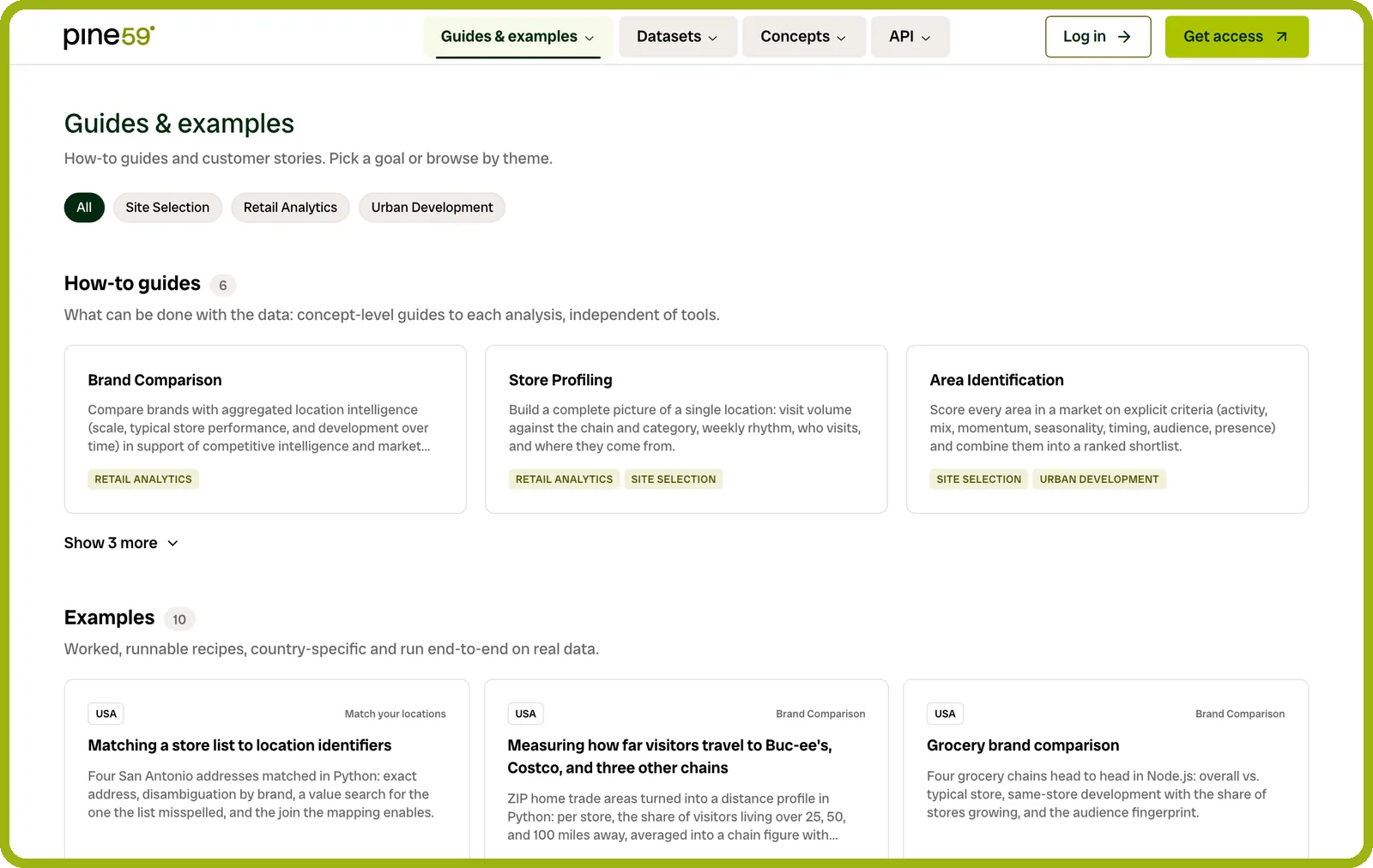
A guide for every question
 Profile any placeA store, mall, venue or park: its visits and visitors, against its chain, competitors and category.Store Profiling, a worked example in the Docs
 Compare brandsEach brand's size, its typical location and how it develops over time.Brand Comparison, a worked example in the Docs
 Rank areasEvery area in a market, scored on what matters to you and ranked into a shortlist.Area Identification, a worked example in the Docs
Start with the Docs, then choose how to work with the data.
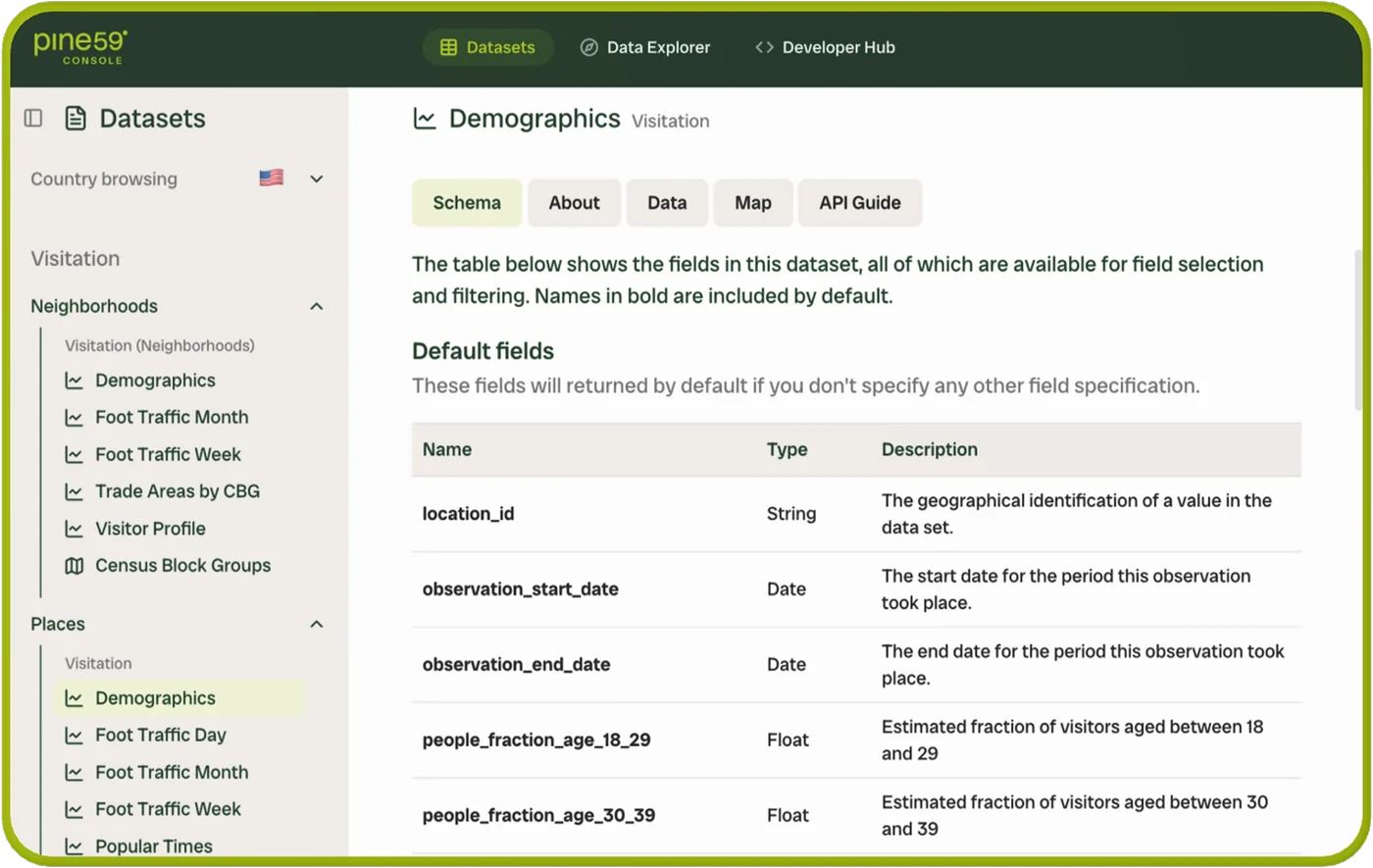
See how every number is made
Privacy built in
Aggregated at the source, never about individual people.
See how privacy worksFoot Traffic clearly defined
What one visit means in our numbers.
Read the visit definitionTerms published in full
What a customer can do with the data, including sharing it with credit to Pine59.
Read the termsBefore getting started
Trusting the numbers
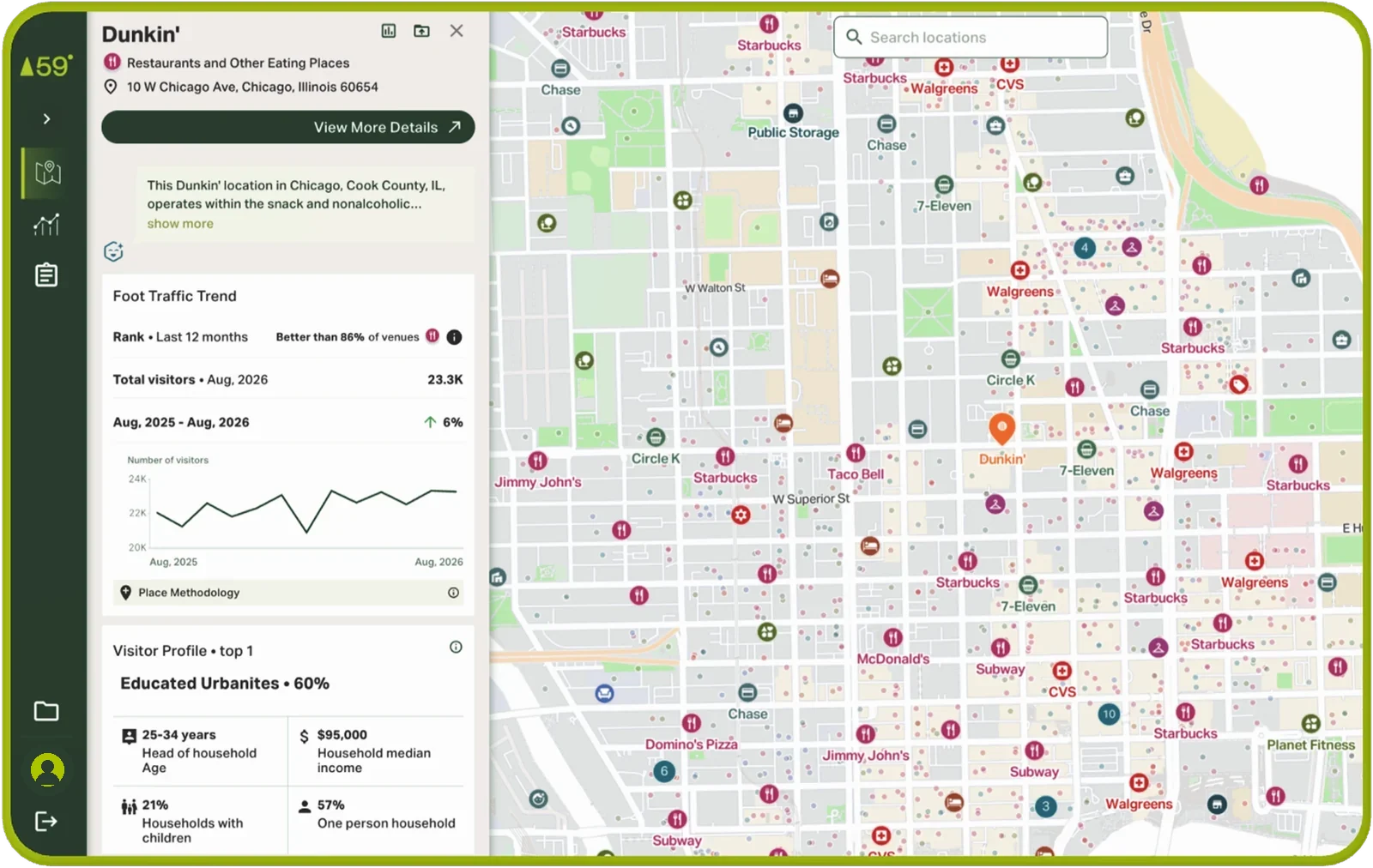
Sales data shows who buys. Trade areas and visitor demographics add who visits each location, buying or not: where they live and work, their age, income and lifestyles, and how that mix compares with the chain, its competitors and the category.

Visitor demographics are modeled from the home areas visitors come from, so read the direction, such as a location that skews younger than its chain, rather than the decimals. Trade-area shares leave out home areas with too few visitors to report, so they add up to less than the whole: read them as a ranking.
No. Home and work are always areas, such as a block group or a ZIP code, never an address. The data is aggregated at the source, small groups are held back, and customers never receive device identifiers or movement histories. The terms also forbid trying to re-identify anyone.
How privacy is built in, in the Docs

In the US, to January 2019, updated every quarter within the first two weeks of the next one. In Norway, Sweden and Finland, to 2023, updated every month.
Using the data
In the US, yes: home and work trade areas by ZIP code or block group, each with its share of the location's visitors, every quarter. In Norway and Finland, the same for places and areas, by statistical tract and postal code. In Sweden, for areas, by district.
How trade areas work, in the DocsIn the US, each brand's visitors side by side: their age, income and lifestyles, and where they come from, plus each brand's mix against its own past. Read the direction of the differences between brands.
Grocery brands compared, in the DocsYes. Trade areas show which ZIP codes each location's visitors live and work in, and demographics show who they are, so campaigns go where the visitors are. The same trade areas come as data for the tools you or your agency already use. The data describes groups of visitors, never a person or a device, so it can't be used to target individual visitors.
Yes, for every place in Pine59's places directory, about 4 million places in the US. Match the list once by address, brand or name, and trade areas, visitor demographics and foot traffic all join on the same location ID. A location that isn't in the directory can be added as a custom location.
Matching a list of locations, in the DocsPlaces and markets
A campaign shows over months, not days, since home and work areas and visitor profiles update every quarter. Pine59 shows where visitors come from and who they are, and running the campaign stays with you. Lifestyle groups are for the US; in Norway, Sweden and Finland, visitor profiles are age and gender.
Every dataset by market, in the Docs
Bring your places.See how they perform.
- 01Your use case
- 02A short meeting
- 03Trial the data
- 04Sign and go live